MAIN MENU

Art, Design and Technology

Art
Art Intent
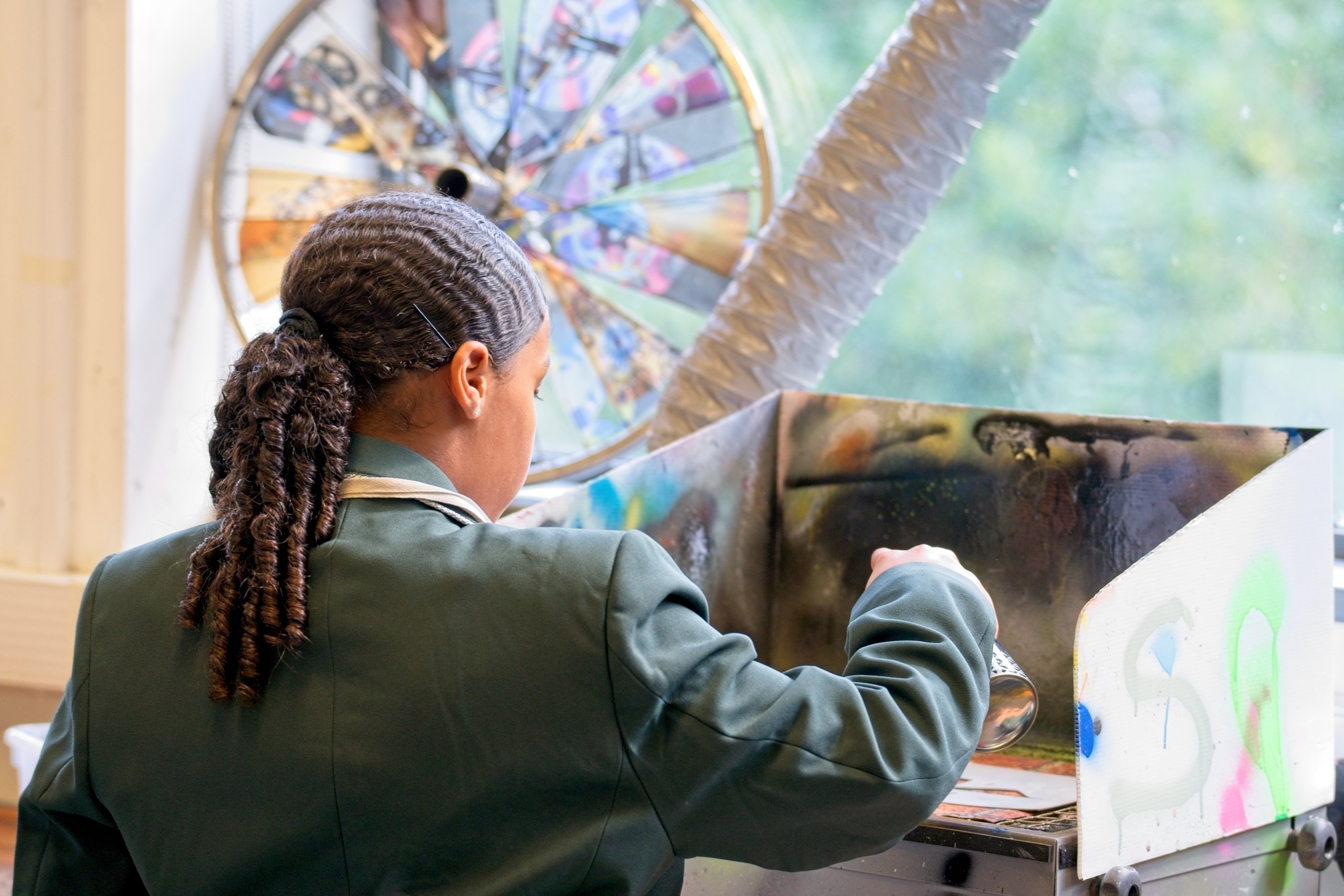
The art department aims to make art and creativity accessible for all. We aim to inspire a passion for art in many different disciplines through an exciting, inspiring and varied curriculum. We aim to develop student’s critical thinking, problem solving skills, fine motor skills, and other transferable skills. We aim for students to have an appreciation for different art forms and a passion for creativity that they take into adulthood either though their work or as a hobby to aid wellbeing.
At KS3 we aim to inspire students by introducing them to artists, craftspeople and different movements in art, alongside using a variety of different media and materials in both 2D and 3D. We aim to do this through delivering different skill builder units. These will all build on the key skill of drawing. We aim to encourage students to express their opinions through written and visual form.
At KS4 we aim to enhance skills in art, to expand student thinking and challenge preconceived ideas. We will encourage students to further develop own opinions, be able to justify these and broaden their own cultural capital. Through different projects, students will explore, experiment, record and present their creative ideas. Students will find their own individual interests and ways to express these through art, both visually and in written form. We aim to celebrate artwork through art exhibitions. We aim to inspire students to learn about the creative industries and different career paths.
Implementation
A wide variety of interesting lessons are delivered. These build on students’ knowledge and understanding in Art. Through different projects, students will explore, experiment, record and present their creative ideas. They will develop their skills in a variety of dry media such as pencil, pastel, and charcoal. Develop skills with wet media such as watercolour, acrylic paint, and different types of printing. Experiment with different disciplines such as textiles, clay, and photography. Students will be introduced to a wide range of different artists to inspire and engage their ideas. Students will also learn about the creative industries and different career paths. We display student’s artwork across the school and have an exhibition of work at the end of every year.
Impact
The impact of the curriculum can also be measured in a variety of ways such as uptake of Fine Art Course at GCSE, A level and beyond, student engagement, work produced, student voice and analysis of data.
Year 7 Art Overview
Year 8 Art Overview
Year 9 Art Overview
Year 10 Art Overview
Year 11 Art Overview
Art Learning Journey
Design and Technology
Design and Technology Intent
In Design and Technology, we want to inspire students to have a passion for good design. We aim for them to develop confidence in taking creative and innovative risks underpinned by the understanding of knowledge, skills, and attributes within the core learning in Design and Technology. Students will understand the impact that design has in the outside world and its resulting implications. We will excite students by looking at current and new innovative technological advances. Student’s will acquire a broad range of subject knowledge and draw on disciplines such as mathematics, science, engineering, computing and art to develop skills, methods of working, ways of thinking and risk taking that can support progression into any profession or occupation.
In KS3, students develop knowledge of materials, functionality, design, and manufacture, and learn to make judgments involving technical, economic, social, aesthetic and sustainable factors. They do this through different units of work. Students will have an understanding of different design movements and begin to understand the design process.
At KS4, we aim for students to develop their independence in the subject and increase their use of experimentation through various design briefs. Students will be inspired and excited, learning different practical skills that will help them to gain a greater knowledge and skill level of different practical techniques and processes. Students will draw upon their own individual interests to solve their design problems through creative and innovative ideas. Students will enjoy designing and making prototypes, problem solving and thinking outside the box, to produce successful and modern products. Students will be able to evaluate and analyse their work in order to be able to further improve ideas.
Implementation:
The Design and Technology curriculum is carefully sequenced to ensure students build on prior knowledge and skills as they progress through Key Stages 3 and 4. At KS3, lessons are structured around a range of practical and theory-based units that teach core concepts such as materials, processes, design thinking, and evaluation. Teachers model key skills and provide opportunities for guided practice, gradually increasing independence. At KS4, students engage in more open-ended design briefs that encourage independence, creativity, and iterative development. Teaching incorporates a balance of practical making, theoretical knowledge, and the use of digital technologies. Subject-specific vocabulary is taught and reinforced. Adaptive teaching strategies ensure all learners can access the curriculum and achieve success.
Impact:
Students develop into confident, creative, and reflective designers who can apply their knowledge and skills to solve real-world problems. They demonstrate resilience and a willingness to take informed risks, producing thoughtful and innovative outcomes. Students show a clear progression in their technical knowledge, practical ability, and evaluative skills from KS3 to KS4. Outcomes at KS4 reflect strong engagement and independence, with students able to articulate their design decisions and respond effectively to feedback. Students leave the course with transferable skills such as problem-solving, critical thinking, and collaboration, preparing them for further education and a wide range of future careers.
Year 7 DT Overview
Year 8 DT Overview
Year 9 DT Overview
Year 10 DT Overview
Year 11 DT Overview
Design Technology Learning Journey
Engineering
Engineering Intent:
In Engineering, we aim for our students to develop confidence in taking creative and innovative risks underpinned by the understanding of knowledge, skills, and attributes within the core learning in Engineering. Students become resourceful, innovative and enterprising through the acquisition of knowledge of functionality, materials, design, manufacture and the positive and negative impacts it has on both people and the planet. In Engineering, we inspire to equip students with the confidence and independence to use skills that are relevant to the engineering design sector and more widely. Student’s will acquire a broad range of subject knowledge and draw on disciplines such as mathematics, science, engineering, computing and art to develop skills, methods of working, ways of thinking and risk taking that can support progression into any profession or occupation.
At KS3, engineering will be imbedded into the Design and Technology curriculum. Students will develop knowledge of materials, functionality, design, and manufacture, and learn to make judgments involving technical, economic, social, aesthetic and sustainable factors. Students will experience purposeful and relevant learning that responds to perceived needs or opportunities which take place within a context of specific constraints.
At KS4, students will build on the skills and knowledge acquired in KS3 Design and Technology. They will specialise in the fundamental principles and concepts of Engineering Design, including the design process, types of drawings, influences on design, and the use of Computer Aided Design (CAD). They will understand the different stages of the iterative design process, recognising the cyclical nature of this approach. They will enjoy evaluating the design of a product, through the disassembly of existing products and the use of modelling for new designs. Students will develop learning and practical skills that can be applied to real-life contexts and work situations. We aim to encourage students to think creatively, innovatively, analytically, logically and critically.
Implementation
The Engineering curriculum is structured to build progressively on knowledge and skills from Key Stage 3 through to Key Stage 4. At KS3, engineering principles are embedded within the Design and Technology curriculum, where students are introduced to core concepts such as materials, systems, design processes, and manufacturing techniques through practical, contextualised projects. Teachers use modelling, scaffolding, and structured tasks to develop students’ understanding, while incorporating opportunities for problem-solving within realistic constraints. At KS4, delivery becomes more specialised, with a clear focus on engineering design principles, including technical drawing, Computer Aided Design (CAD), and the iterative design process. Students engage in a range of design-and-make activities, product analysis, and disassembly tasks to deepen their understanding of how products function and are developed.
Impact:
Students develop into confident and capable problem-solvers who can apply engineering knowledge creatively and effectively in a range of contexts. They demonstrate an understanding of the design process, including the ability to iterate, evaluate, and refine their ideas. By the end of KS4, students show increased independence, resilience, and the ability to think analytically and critically when approaching engineering challenges. Their work reflects a secure grasp of technical concepts, practical skills, and the ability to communicate ideas through appropriate methods such as technical drawings and CAD. Outcomes demonstrate high levels of engagement and a readiness for further study or careers within engineering and related fields. Students leave with transferable skills such as logical thinking, innovation, and problem-solving, equipping them for success in an increasingly technological world.
Year 10 Engineering Overview
Year 11 Engineering Overview
Food Technology
Food Intent
The Food department aims to teach students to cook and apply the principles of nutrition and healthy eating. We aim to instill a love of cooking, through learning crucial life skills that will enable students to feed themselves and others affordably. The subject will promote opportunities for students to engage further and develop skills with food preparation through enrichment activities.
At KS3, we aim to ensure that students develop a curiosity for food and cooking and that they are open to tasting new foods. They will enjoy preparing, cooking and serving mainly savoury dishes for their families in line with the principles of the eatwell guide. We will teach the importance of making the right food choices for a healthy life, teaching an understanding of nutrients and their functions. Students will study food provenance and food origins, considering where and how foods are grown, reared, or caught. Student will be taught about food choices such as buying organic or fair trade foods. Students will learn and develop an understanding of food safety, including the preparation and safe storage of food, microbiological food safety principles, and how to use equipment effectively and safely.
At KS4, we aim to develop and enhance students skills in food where they will specialise in hospitality and catering. Through practical lessons, we aim for students to be able to cook confidently in the kitchen. They will prepare different dishes while showing their understanding of individuals with specific dietary needs. Students will be able to independently plan their own recipes, demonstrating appropriate skills and evaluating their dishes. We aim for students to develop a curiosity for hospitality and catering services, including provision, health and safety, and food safety.
Implementation:
The Food curriculum is designed to develop practical cooking skills alongside a strong understanding of nutrition, and healthy living. At KS3, students follow a structured programme of learning that combines theory with regular practical cooking lessons. Key skills such as knife techniques, food preparation, and cooking methods are taught and demonstrated by teachers, with opportunities for students to practise and refine these skills over time. Lessons are carefully sequenced to build knowledge. Students are encouraged to taste and evaluate a wide range of dishes, developing confidence and curiosity. At KS4, teaching becomes more specialised within hospitality and catering, with a greater emphasis on independence, planning, and decision-making. Students undertake more complex practical tasks, plan and prepare dishes to meet specific dietary needs, and apply their understanding of health, safety, and nutrition in real-life contexts. Ongoing assessment, feedback, and opportunities for reflection ensure students can refine their skills and improve outcomes.
Impact:
Students become confident and competent in the kitchen, able to prepare a range of nutritious meals independently. They develop a strong understanding of healthy eating, nutrition, and the importance of making informed food choices. Students demonstrate increased confidence in using equipment safely and effectively. By KS4, students show independence in planning, preparing, and evaluating dishes. Outcomes reflect strong engagement and enjoyment of the subject, with many students developing a sustained interest in food, hospitality, and catering. Students leave with essential life skills, including organisation, and time management, as well as an understanding of how to maintain a healthy lifestyle, preparing them for adult life and potential careers in the food industry.